
What is Feminine Identity in the Modern Western World?
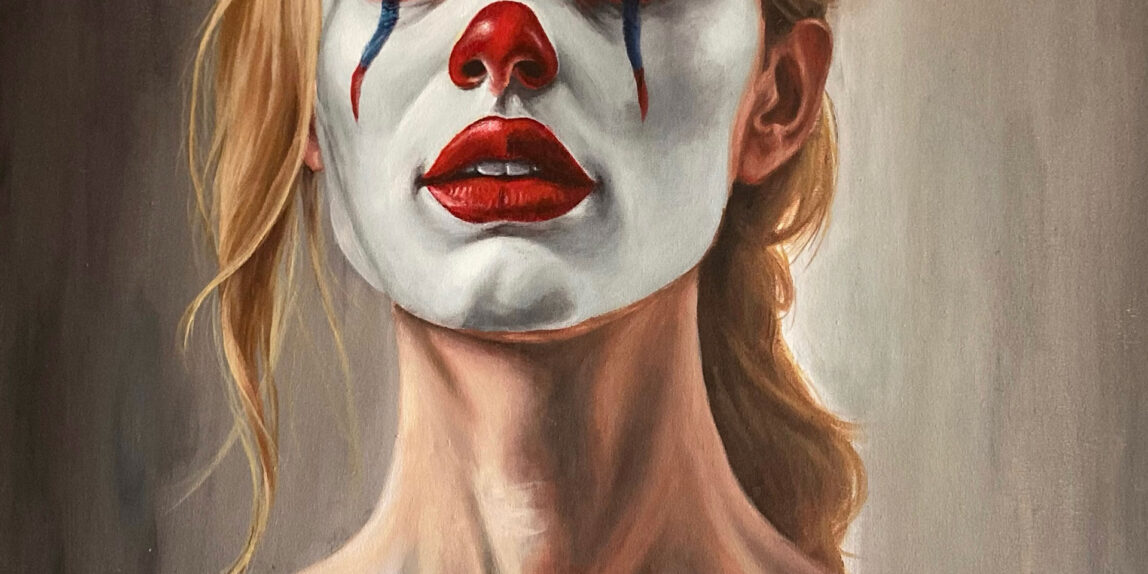
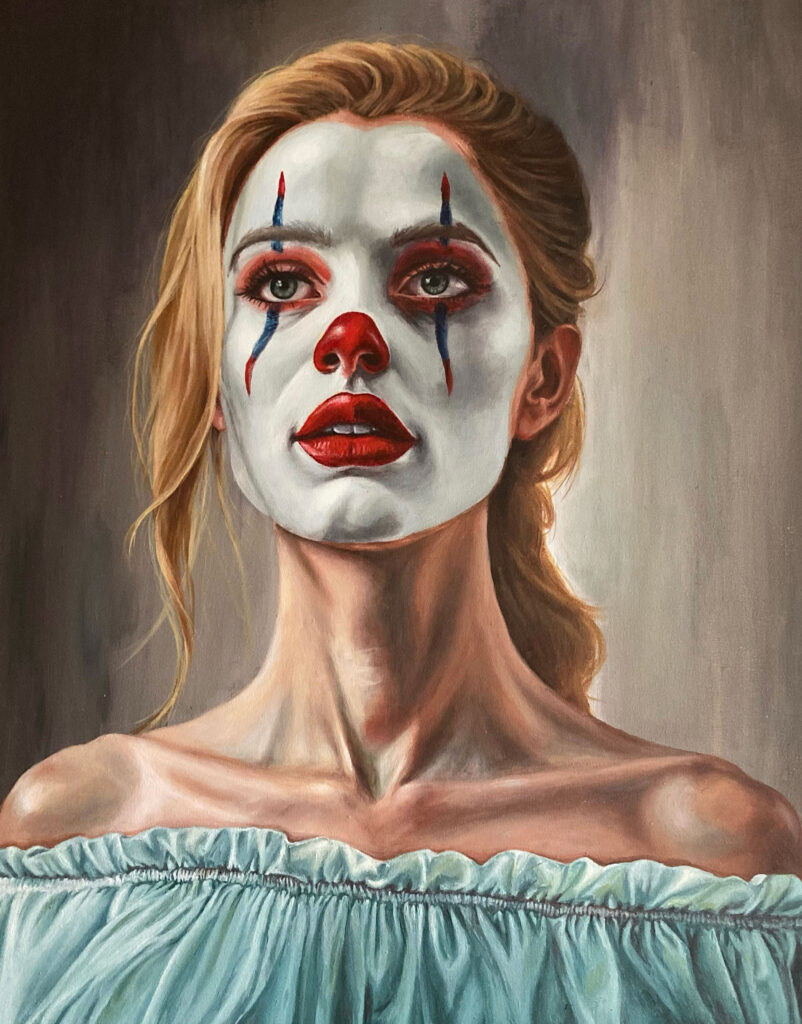
In Performance of Femininity, I explore feminine identity in contemporary art through the unsettling, symbolic figure of the clown. At first glance, the painting presents a portrait of a woman in full clown makeup. Her face is painted, her lips exaggerated, her expression caught somewhere between wistfulness and resignation as she gazes beyond the frame. But beneath the theatrical surface lies something far more personal and political.
This clown painting is not about comedy. It is about expectation.
In Western society, we women are increasingly pressured to maintain a version of ourselves that is palatable, youthful, and polished. Cosmetic procedures have become normalised. Skincare routines have expanded into ten-step regimens. Social media feeds are saturated with filtered perfection and celebrity-defined beauty standards. The message is constant and insidious – improve, enhance, conceal, perfect.
Given what we now know about the powers that be, it’s hardly surprising that we spend way too much of our precious time trying to look younger. The release of the Epstein Files has shone a glaring light on the world of billionaires and Hollywood. On the discovery that paedophiles run the world, it’s more understandable that their messaging is: “Don’t Age.” And yet, despite the realisation that this is why women are expected to stay young and slim, we are still going through the motions.
I wrote in a previous blog post about how body positivity is an act of rebellion in a world that reveres thinness. Again, children are thin, hairless, hipless, undercooked. Grown women are none of these things, and yet we all seem to strive for it at any cost. Our feminine identity has been hijacked. We’ve lost contact with what it means to be women over centuries of gaslighting and patriarchy.
The Masks We Wear to Claim Our Feminine Identity
Clowns exaggerate their features to entertain. Their smiles are painted on. Their expressions are fixed regardless of what they may feel internally. In much the same way, women are often expected to present a socially acceptable face to the world. We’re supposed to be pleasant, composed, attractive, young, smooth, flawless. These things are expected of us even when we are exhausted, angry, grieving, or disillusioned.
The makeup becomes armour. But it is also a mask. The clown makeup in this painting acts as a metaphor for the veneer we put forward as women in modern society. We block out our faces with makeup and then paint them back on in brighter, bolder colours. One thing I am really enjoying at the minute is seeing women using makeup as a way to repel, rather than attract, men. The bright colours are used instead as a warning, much like in the poison dart frog.
The Smile That Isn’t a Smile
One of the most persistent demands placed on women is to smile. The “smile more” culture is deeply ingrained, from customer-facing jobs to everyday social interactions. A woman’s emotional state is frequently treated as public property, subject to commentary and correction.
In Performance of Femininity, the painted smile contrasts with the subject’s distant gaze. She is not engaging the viewer directly. She is looking beyond us, beyond the performance. The smile remains, but the eyes betray something else. Thoughtfulness, yes, but also a touch of fatigue and resignation.
Clowns are designed to amuse. But they are also unsettling. There is a reason that the “sad clown” archetype resonates so strongly in popular culture. The tension between external cheer and internal despair feels uncomfortably familiar.
For many women, the pressure to remain agreeable can create a split between inner truth and outer presentation. The clown becomes a visual shorthand for this emotional dissonance.
Consumption and Control
The modern beauty industry thrives on dissatisfaction. Anti-aging products promise to rewind time. Cosmetic enhancements promise to “correct” natural features. Trends shift rapidly, ensuring that no standard remains stable long enough for anyone to feel secure.
This constant cycle of improvement encourages women to see themselves as ongoing projects. Never complete and, more importantly, never enough.
In this context, the clown makeup in the painting becomes more than theatrical decoration. It becomes commentary on consumer culture. Each layer of paint represents another product, another expectation, another attempt to conform to an ever-shifting ideal.
And yet, there is irony here.
Clown makeup is excessive by design. It is obviously artificial. By exaggerating the concept of enhancement, the painting exposes the absurdity of the system itself. If we must perform, then let the performance be visible.
Rage Beneath the Rouge
There is anger in this work.
Not loud, explosive anger, but the steady, simmering frustration of living within systems that police appearance and reward conformity. The subject’s gaze suggests an internal world that is far richer and more complex than the surface presentation allows.
Women are frequently told that anger makes them unattractive, hysterical, dramatic. Emotional restraint is praised. Composure is rewarded.
The clown, paradoxically, allows for emotional exaggeration. Yet even here, the emotions are scripted.
In Performance of Femininity, the rage is not painted on. It exists beneath the surface. The viewer senses it rather than sees it. This subtlety is intentional. The painting asks: how much of ourselves do we conceal in order to survive socially?
Feminine Identity in Contemporary Art
Contemporary art has long been a space where artists interrogate the construction of identity. Feminine identity, in particular, has been explored through themes of beauty, domesticity, sexuality, labour, and performance.
This clown painting situates itself within that broader conversation. It questions the idea that femininity is natural or fixed. Instead, it presents femininity as something rehearsed, maintained, and often demanded.
To perform femininity is to understand the rules of the stage: when to speak, when to soften, when to smile. But performance implies audience. Who are we performing for? And what happens when the performer grows tired?
The subject’s wistful gaze hints at a longing for authenticity. A space beyond performance.
The Portrait as Protest
Though visually striking, Performance of Femininity is quiet in its protest. There are no overt slogans. No dramatic gestures. The resistance lies in the symbolism.
By likening modern beauty standards to clown paint, the painting invites discomfort. It asks viewers to reconsider what we accept as normal. Why do we view heavy theatrical makeup as absurd, yet treat everyday cosmetic excess as obligatory?
The clown becomes a mirror
If the image feels exaggerated, perhaps that is the point.
Beyond the Canvas
Ultimately, this work is about recognition. It is about acknowledging the invisible labour of self-presentation. It is about validating the internal experiences that exist beneath polished exteriors.
The woman in the painting is not weak. She is aware. She understands the performance. And perhaps, in that awareness, lies the beginning of refusal.
Performance of Femininity is not just a clown painting. It is an exploration of how women navigate visibility, expectation, and identity in the modern world.
And sometimes, the bravest act is to let the paint crack.