
A Whimsical Painting of a Shining Beacon in the Dark Forest
In my whimsical painting, Lumina, I explore the tension between fragility and power through aethereal art.
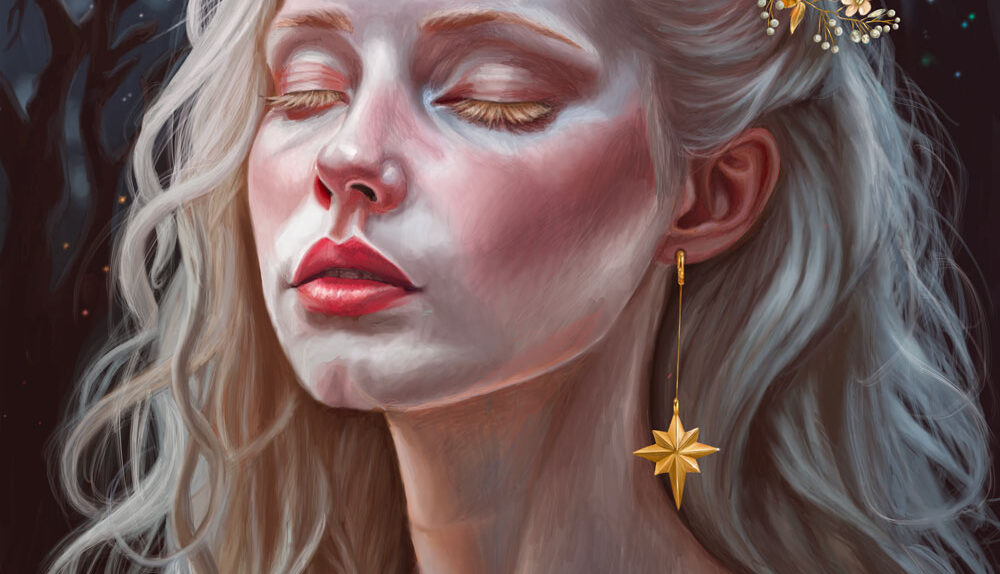
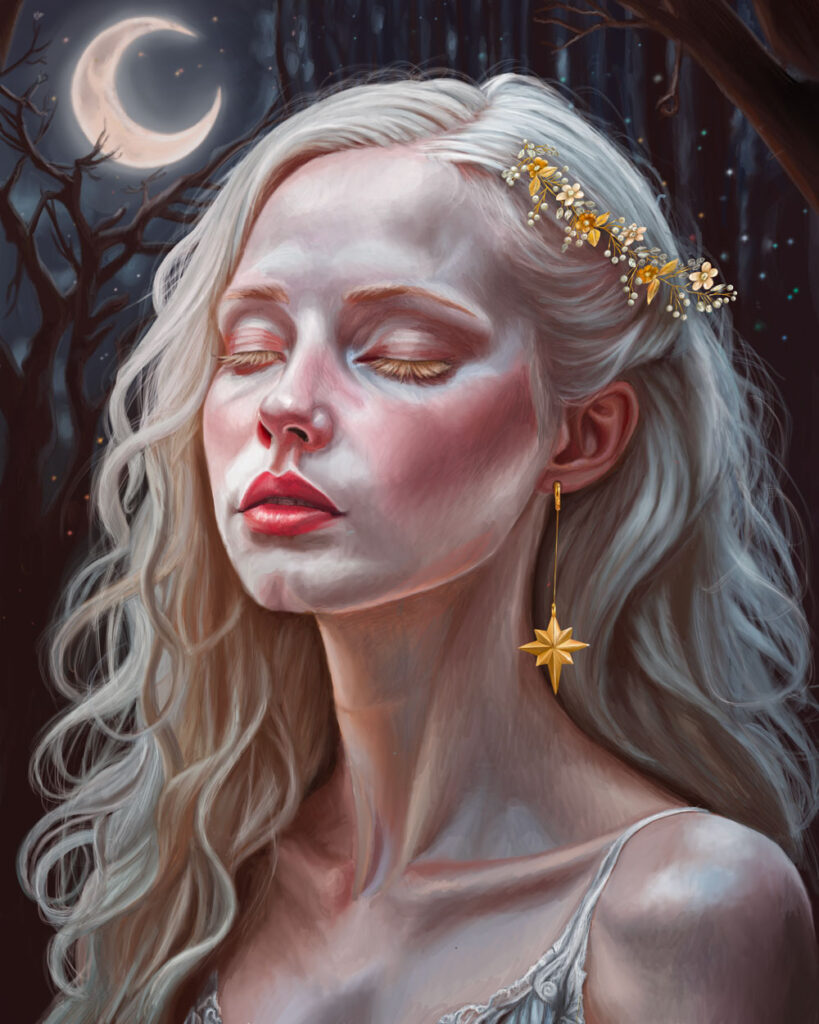
The piece features a young, fair girl, her eyes gently closed, suspended in a moment of quiet transcendence. She stands before a midnight forest of twisted black trees, beneath an exaggerated crescent moon. Sparkles surround her. She does not look at us. There is no need for her to. She simply radiates.
At first glance, Lumina may seem like just a pretty, whimsical painting of a pale figure beneath a crescent moon. But the longer you stand before her, the more you begin to recognise yourself. The twisted trees behind her are not just branches – they are the parts of us that we were taught to hide. We were told that our anger and your ambition are callous. The emotions we hide away in the dark simmer below the surface and become a dark presence in our lives.
When you take charge of your shadow self and accept her in this way, she becomes a part of you that you are deeply connected to.
The Meaning of “Lumina”
The title Lumina derives from the Latin word for light. It suggests illumination, clarity, and quiet brilliance. This was essential to the concept of the piece.
The subject’s albinism becomes a natural source of symbolism. Her very colouring (the pale skin, fair hair, delicate lashes) reflects and holds light in a way that feels almost supernatural. Rather than portraying albinism as something fragile or othered, I wanted to frame it as luminous, powerful, and mythic.
She is not fading into the darkness. Rather, she is defining it.
Eyes Closed on Her Inner Light
In traditional portraiture, eye contact often creates connection or confrontation. Here, the closed eyes shift the energy inward and add to that whimsical painting feel. This is not a girl performing for the viewer. She is not seeking validation. She is immersed in her own interior world.
The closed eyes suggest meditation, dreaming, or communion with something unseen. In aethereal art, subtle gestures carry emotional weight. The absence of gaze invites contemplation. It asks the viewer to pause and consider what it means to exist without constantly being observed.
There is peace in her stillness.
The Eight-Pointed Star Earring
The gold eight-pointed star earring is more than decorative. The eight-pointed star has appeared throughout history and mythology, often symbolising balance, regeneration, and cosmic order. It is associated with celestial navigation and divine guidance.
By placing this symbol on her ear, it suggests communication with an unseen force that guides and protects the wearer. The star suggests she is attuned to something beyond the visible world. Perhaps the cosmos itself. It reinforces her connection to the sky above her, where the exaggerated crescent moon hangs heavy and luminous.
Gold, too, carries meaning. It symbolises divinity, permanence, and radiance. Against the cool tones of the midnight blue sky and black forest, the gold element glows with warmth and authority.
Nature, Ornament, and Identity in this Whimsical Painting
My subject’s rose gold hair clip, adorned with gold leaves, orange flowers, and tiny white pearls, bridges the boundary between the human and the natural.
The leaves echo the forest behind her, but they are refined, stylised, precious. The flowers suggest life even in darkness. The pearls add softness and purity, tiny points of light nestled among the metallic sheen.
These adornments elevate her from mere woodland figure to something mythic. A nymph, perhaps, but not a fragile one. She is crowned by nature, but she is not consumed by it.
There is careful balance in the composition. The darkness behind looms magical and impenetrable. In comparison, Lumina and the moon behind her glow in a magical way.
The Forest as Shadow
The backdrop of Lumina is not a gentle, welcoming woodland. The trees are black and twisted. Tangled like veins or reaching fingers. They create a sense of depth and unease.
The forest represents the unknown, its dark shadows suggesting fear and complexity. It is the space we must move through in order to grow.
And yet, she stands calmly before it.
In aethereal art, the environment is key, because it shapes narrative. The darkness amplifies her glow. Without the forest, her luminosity would not feel as striking. Without the shadow, the light would lack context.
This interplay between light and dark is central to the piece. It is not about eliminating shadow. It is about existing within it without being diminished.
A Whimsical Painting that Speaks to Shadow Work
Beyond its visual contrasts, Lumina also speaks to the concept of shadow work and the personification of the shadow self.
The dark, twisted forest behind her can be read as the unconscious. Those parts of ourselves we repress, deny, or fear. In psychological terms, the “shadow” holds that everything we are taught is unacceptable. Often, our anger, desire, ambition, vulnerability and grief are pushed down inside. Rather than turning away from that darkness, she stands calmly before it. Her closed eyes suggest not avoidance, but integration. She is not consumed by the shadow. She acknowledges it.
The glow that surrounds her becomes symbolic of awareness. This whimsical painting suggests the light that emerges when we dare to confront what lies within. In this way, Lumina becomes not just an ethereal portrait, but a meditation on wholeness. Light does not exist without shadow, and true luminosity comes from embracing both.
Lumina herself is a representation of the powerful being we become when we embrace our shadow.
The Sickle Moon
An exaggerated crescent moon looms above our subject like a celestial guardian. The crescent phase is traditionally associated with growth, intuition, and feminine energy. It represents becoming rather than completion. The moon does not blaze like the sun, but reflects its light.
Similarly, Lumina is not about aggressive brightness. It is about quiet reflection, soft power, and the glow that comes from within. The deep midnight blue sky enhances this feeling of vastness and mysticism. It invites the viewer into a liminal space. One somewhere between waking and dreaming.
Sparkles and Aether
The sparkles surrounding the subject add to the otherworldly quality of the piece. They are not chaotic; they feel intentional, like fragments of stardust caught in still air.
These tiny points of light suggest magic, but also possibility. They create a halo-like aura without formalising it into religious imagery. She becomes celestial without being sanctified.
This is where the piece leans fully into aethereal art. The digital medium allows for luminosity that feels almost untouchable. A glow that would be difficult to achieve in traditional paint alone. The sparkles are subtle reminders that she is not bound entirely by the physical world.
Reframing Fragility as Power
There is a cultural tendency to associate paleness, softness, and delicacy with vulnerability. In Lumina, those qualities become strengths.
Her fairness does not make her disappear – it makes her radiant. The closed eyes imply self-containment. Her stillness is not passivity, but composure.
In a world that often equates power with noise and dominance, this portrait proposes an alternative: power as presence.
The Myth of the Woodland Nymph
Lumina draws on that mythic lineage while modernising it. This is not a classical oil painting of pastoral innocence. This is a contemporary digital exploration of identity, light, and belonging in a world filled with darkness and pain.
She is both ancient and modern. Both human and mystical creature. A corporeal being with a spiritual power.
A Whimsical Painting of Quiet Radiance
Ultimately, Lumina is about contrast and the ways in which our own self-discovery and recovery. Light in the dark. Stillness in chaos. Softness against severity.
It invites the viewer to reconsider what strength looks like. It suggests that luminosity does not require spectacle. Sometimes it is enough simply to exist fully, even in the shadow of twisted trees and midnight skies. And owning your shadow self to unlock the magic of your own very being.
In creating this piece, I wanted to capture that rare, suspended moment when the world feels hushed. When something sacred hovers just beyond explanation.
When you take charge of your shadow self and accept her, she becomes a part of you that you are deeply connected to. And the kind of inner power that looks its shadow self in the eye and embraces it, is one that can radiate outwards and dispel the darkness in the world.
And as you meet her closed-eyed stillness, you may begin to feel it too – that steady, luminous strength that comes from no longer fearing your own dark.
This whimsical painting is a reminder of just how powerful and magical you are. Every part of you.